Free TPI golf screening in Carlsbad
With Dr. Brian Fonseca, PT, DPT, TPI Level 1
Here at Valor Physical Therapy, we offer TPI-certified physical therapy as well as free golf mobility and performance screenings led by Dr. Brian Fonseca, PT, DPT. These screenings show which parts of your swing are limited by mobility, stability, or strength, so your practice goes where it will actually help.
- Cost: free
- Time: about 20 minutes, one-on-one
- Where: in person at Valor Physical Therapy, 2150 Palomar Airport Road, Suite 210, Carlsbad
- Who: Dr. Brian Fonseca, PT, DPT, Certified Titleist Performance Institute (TPI) Level 1
- You leave with: the main things limiting your swing and where to start
What to expect at a screening
Three simple steps in about 20 minutes
1. Talk it through
A few quick questions about your game, your goals, and any aches or past injuries.
2. Move and measure
You work through the tests while Brian notes what he sees on each side of your body.
3. Get your takeaways
You leave knowing the main things limiting your swing and where to start.
What the screening looks at
The tests and what each one shows
In 20 minutes you'll move through a focused set of simple physical tests. Brian picks the ones most relevant to you, and each connects to a pattern that shows up in golf swings.
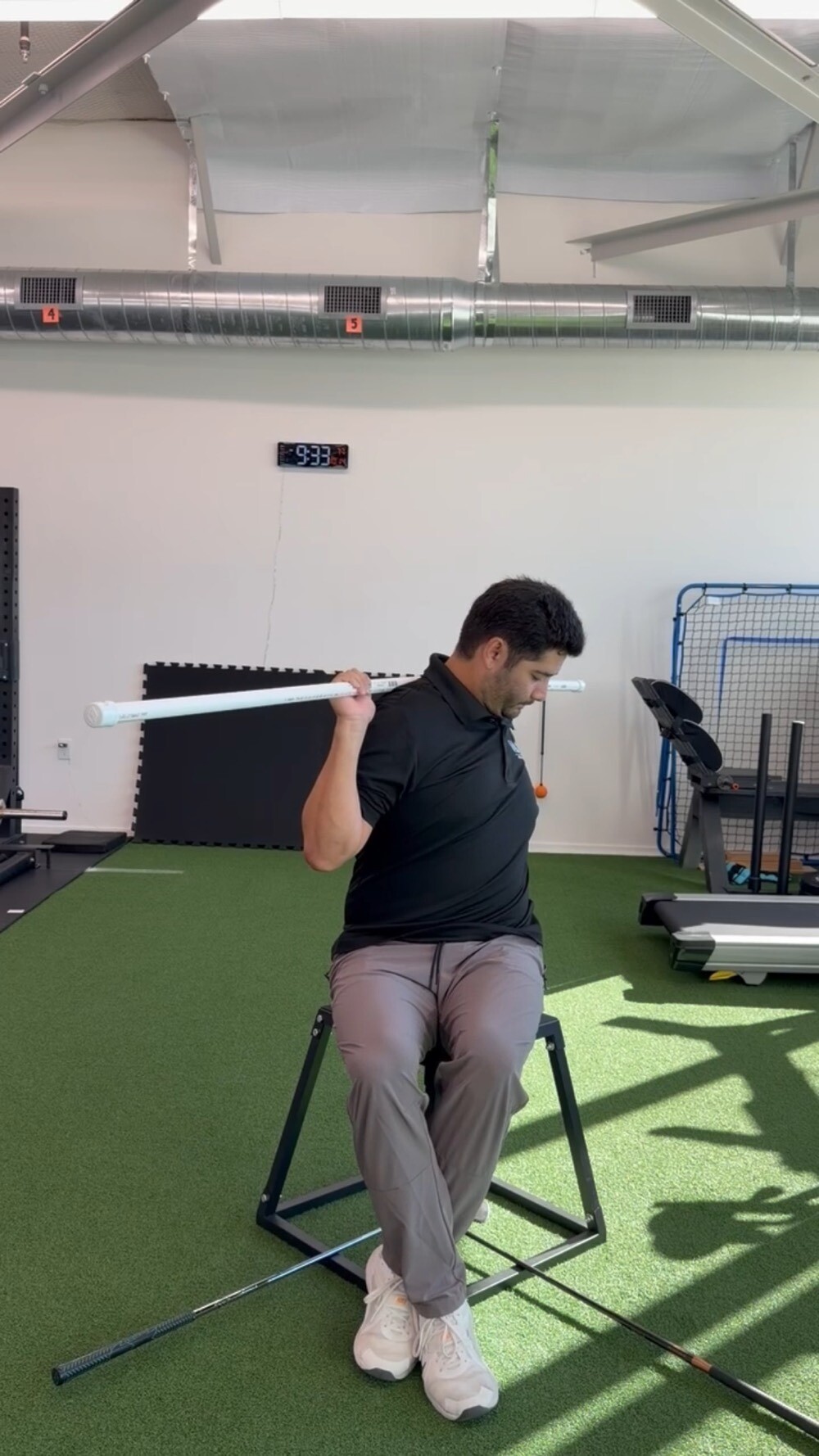
| Test | Body area | What it shows for your swing |
|---|---|---|
| Overhead deep squat | Hips, ankles, upper back | Shows how these areas handle load, which affects posture and balance through the swing. |
| Pelvic tilt | Pelvis, lower back | Checks whether you can set and hold a neutral spine angle at address. |
| Torso rotation | Upper body | Measures how far your upper body turns, separate from your hips. |
| Hip rotation | Hips | Looks at each side's internal and external range, which often explains early extension and sliding. |
| Single-leg balance | Legs, core | Tests the stability you need to stay centered when the club accelerates. |
| Shoulder 90/90 | Shoulders, arms | Finds restrictions that cause the club to come across the line or lose its plane. |
If a test is hard today, that still tells us something useful. It shows Brian where your body is limiting your swing and where to start.
How your body shows up in your swing
Why a stiff hip can feel like a swing problem
Your swing works like a chain. When one part of your body can't move well, another part picks up the slack, and that often shows up as a swing fault or soreness after a round.
The lower back is a common example. Its primary movements are forward and backward bending, rather than rotation. When the hips or upper back lack mobility, the lower back may compensate by taking on additional movement that it's not ideally suited to handle. Tight hips can also show up as early extension, sway and slide that all can lead to inconsistent swing paths.
That's why the screening looks at your body as well as your swing. A lesson shows you the position you're after, and the screening shows whether your body can get there yet.
Who is this for
- Golfers who've plateaued despite lessons and range time
- Players dealing with back, hip, or shoulder soreness after rounds
- Anyone returning to the game after time off
- Anyone who wants to improve their game
What to know
- The screening is free and takes about 20 minutes.
- Wear comfortable clothes you can move in.
- Bring your own clubs and golf shoes if you have them. We have clubs at the clinic, and your own are usually fitted for you.
- A screening is not a medical exam. If something looks like it needs a doctor or physical therapist, Brian will tell you.
- All ability levels are welcome.
Common golf aches we see
And where they often start
Golf asks a lot of a few joints, swing after swing. These are the aches we see most in golfers, and the screening can help show where they start.
- Low back: often tied to stiff hips or a stiff upper back. Learn more about back pain treatment.
- Hips and knees: the lead leg takes a lot of load as you turn through the ball. Learn more about knee pain treatment.
- Shoulders: often linked to limited rotation at the top of the backswing. Learn more about shoulder pain treatment.
- Elbows and wrists: often tied to grip pressure, practice volume, or hitting off hard mats.
If something hurts, the screening is a good place to start the conversation.
Meet Dr. Brian Fonseca, PT, DPT
Certified Titleist Performance Institute (TPI) Level 1
Brian is a licensed physical therapist and holds a Titleist Performance Institute (TPI) Level 1 certification. He earned his Doctorate of Physical Therapy from the University of St. Augustine in 2024 after his undergraduate degree at San Diego State University.
He grew up playing baseball, still plays in an adult Sunday league, and has a newfound love for golf. He enjoys working with athletes and weekend warriors of all ages. Read Brian's full bio.
After the screening
Your results, your choice
You leave with your results and a clear place to start. What you do next is up to you.
Work on it yourself
Brian can point you to a few movements that target what he found.
Book a full evaluation
A one-on-one session with Brian to look closer at pain, an old injury, or a bigger limitation, and build a plan around your game. Learn more about sports injury rehab.
Measure your strength and power
During a full evaluation, Brian can add VALD performance testing, which measures strength, power, and side-to-side differences you can track over time.
Frequently asked questions
Quick answers about the golf screening
Yes. The screening is free and takes about 20 minutes. If you'd like to keep working with Brian afterward, he'll explain your options, and the choice is yours.
You start with a short conversation about your game and any aches. Then you move through simple tests such as an overhead deep squat, pelvic tilt, torso and hip rotation, single-leg balance, and shoulder 90/90. Brian explains what each result means for your swing.
No. In California you can see a physical therapist without a referral, and the screening is a movement assessment rather than a medical exam. Read more about referrals for physical therapy in Carlsbad.
No. Many golfers come in because they've hit a plateau or want more consistency. If you do have pain, tell Brian so he can take it into account.
Yes. The screening looks at how your body moves, and that matters at every level. Knowing what your body can do today helps you and your coach choose the right things to work on.
No. Titleist Performance Institute in Oceanside is best known for club fitting. Our screening looks at how your body moves, so it pairs well with lessons or a fitting.