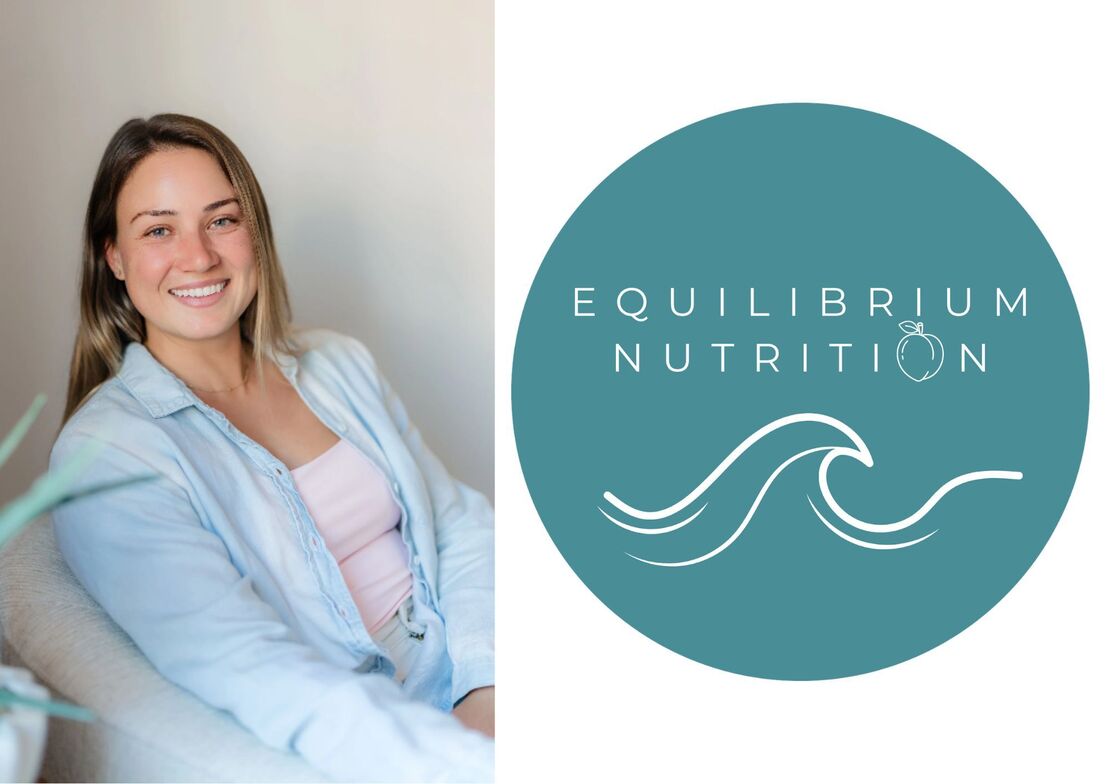
Tatum Vedder is a Registered Dietitian and Certified Personal Trainer, and the founder of Equilibrium Nutrition in San Diego and Santa Barbara. After six orthopedic surgeries over four years, and very little nutrition guidance along the way, she built her practice around helping athletes, active adults, and professionals fuel for performance, injury and surgery recovery, gut health, and hormonal changes.
Her Story
Tell us a little about yourself and how you became a dietitian.
I was raised in a health forward family alongside being exposed to many sports throughout my childhood. Volleyball took the main stage for my sport since age 12 in which I was eager to find ways to improve my performance. Yet, my efforts backfired and I unknowingly developed disordered eating coupled with a gut condition that perpetuated throughout high school and even to this day that I have to manage.
I was furious with the lack of guidance and answers in Western conventional medicine to heal my gut issues and turned to more functional and holistic approaches. This sparked my interest in health beyond the typical model we see. A world of exploration and learning that I grew passionate for. Furthermore, I worked in an eating disorder clinic while earning my degree towards becoming a dietitian that opened a new door to nutrition. This cultivated my philosophy of nutrition and health in a very balanced manner, to tend to the brain and body, not just the body.
Lastly, with a knee injury in college volleyball that lasted four years with six surgeries to follow, I yet again found myself in a place where conventional medicine could not answer my questions on how to eat to support recovery and healing. I researched and dug into the science to answer my own questions. My desire to help others through fueling for performance, healing gut issues, mending their relationship with food and supporting recovery from injury or surgery are fully encompassed by my own journey.
Fueling & Recovery
What's the most common nutrition mistake you see people make?
Undereating, believe it or not. Often characterized by skipping breakfast and having incomplete meals, suboptimal snacks and large dinners, making them sluggish and negatively impacting their sleep.
Why do you believe "healing requires fueling"?
On a cellular level, mending requires nutrients to be put back together, repair, patch, and fire up for energy. Fuel provides nutrients that are the building blocks to do so.
What does "finding your equilibrium" look like in everyday life?
Waking up early to surf and coming home to a nourished meal that I prepared ahead of time so that I can support my clients virtually in a calm and timely manner. Listening to my body when I am ready to hit the gas in a workout and when I would benefit myself from a stroll around the neighborhood instead.
Strength, Bones & Your Relationship with Food
What role does nutrition play in muscle and bone health as we age?
Many nutrients like calcium, vitamin D, omega-3’s, protein, vitamin K, magnesium and more support the strength, building, repair of muscle and bone. When we age, these nutrient needs shift with the natural decline of muscle mass and bone density. It requires more focus and attention by strategizing meals and snacks rich in these foods and being proactive about seeking out these sources in our day to day.
How do you help clients build a healthier relationship with food?
Reversing the mentality of eating less and working out more by using an “add-in” approach. When we find ways to “add in” protein, snacks, fiber, water, walks, strength training, and even our fun treats strategically, we don’t feel so deprived anymore. When we target a balanced way of eating, the restriction mentality starts to diminish and the hold food and dieting had over us previously starts to loosen its grip. I work to support an improvement in language used towards food like labeling “good” and “bad,” as well as, our body image.
What's one small habit you'd recommend to almost anyone?
Sneak veggies into your foods the best you can. Fiber goes a long way and has so many roles in our body; metabolism, appetite, gut health, blood pressure, cholesterol, weight, brain (from gut health), inflammation, you name it. Veggies are easy to undereat but very easy to incorporate when you know how. I work with clients on this.
Beyond the Practice
When you're not working with clients, what does your own eating and training routine look like?
My appetite is large and in charge in the morning, I eat within 10-30 minutes of waking, often a savory high protein and fiber breakfast for blood sugar control.
My workout time is variable depending on my client sessions for the day and the forms of workouts I do.
Beach volleyball is dependent on getting three other girls to decide on a time, the wind, the sun (dang time change), and if my knee is ready for another set of games (remember those six surgeries I mentioned). So that occurs about 1-2x/week.
Surfing depends on the swell, wind, and how much time I would have to wash my hair. I can squeeze this in anywhere from 0-3x/week. Ideally the latter.I swim 1-2x/week (also the hair predicament).
I lift in the summer once a week focusing on legs that are very rehab based to keep my knees and back in solid shape for volleyball and surfing.
In the winter, when the daylight is shorter and the water is quite cold despite a good wetsuit, lifting starts to bump to 3x/week. I walk often once a day if not twice, but sometimes none…because balance :)
I eat every 3-5 hours for blood sugar and hormone support as well as giving myself the opportunity to get in enough protein, fiber and energy in general! I lead an active lifestyle and want to keep it that way which means my needs are close to 2,600 calories a day! I do not track what I eat, count calories, measure food, or avoid any particular foods or food groups.
Myths & Advice
What's a nutrition myth you wish people would stop believing?
Eat less, exercise more for weight loss. Weight is so nuanced and there are so many factors at play that just isn’t as simple as that short intervention. There is a time and place for calorie reduction and increasing output, but it is not the only approach and certainly not for everyone.
What advice would you give someone who feels overwhelmed and doesn't know where to start with their nutrition?
Start finding ways to add more whole foods into your diet and weeding out the processed choices. Higher protein and fiber is often a great place to start, but isn’t for everyone. Nutrition is individualized. In addition to getting individualized support, check out nutrition episodes from the Huberman Lab Podcast or Holistic Health Podcast!
We're grateful to Tatum for sharing her story and her approach to nutrition. Whether you're recovering from surgery, navigating hormonal changes, or just want to feel stronger in your everyday life, our two practices exist for the same reason: to help this community move well and recover fully.
To work with Tatum, book a free discovery call at equilibriumnutrition.net. You can also hear her speak at the Women in Perimenopause & Menopause health seminar on Saturday, November 7 in Carlsbad. And if it's an orthopedic or sports injury you're dealing with, schedule a visit with Valor PT. We'd love to help.
About Equilibrium Nutrition: Equilibrium Nutrition provides evidence-based nutrition counseling for athletes, active adults, and professionals in San Diego and Santa Barbara, with a focus on performance, injury and surgery recovery, gut health, and hormone support. Learn more at equilibriumnutrition.net.
About Valor Physical Therapy: Valor Physical Therapy is a cash-based, one-on-one physical therapy practice in Carlsbad, CA, helping active adults and athletes move and recover without pain. Learn more or book an appointment at valor-pt.com.