If you or someone you love has been diagnosed with osteoporosis or osteopenia, exercise can feel intimidating. The fear of fractures is real, but so is the evidence that the right exercise program is one of the most effective tools for managing bone density and staying active. Here's what a physical therapist wants you to know.
Bone density and exercise
At our Carlsbad physical therapy clinic, one of the most common questions we hear from patients newly diagnosed with osteoporosis is whether it is safe to exercise. First and foremost, exercising is safe to do so long as it is scaled appropriately to each individual person. Some of the common sites of osteoporosis tend to be in the hip and spine, especially the transitional zone between the mid and lower back (the thoracic and lumbar regions). However, it can occur in any bone and knowing high risk locations is important in determining the most appropriate exercise program.
Once you know where your bone density is affected, you can exercise more confidently. Depending on the severity of your dexa scan results for the spine, it is best to avoid deep end range movements like forcing forward flexion and extreme twisting of the trunk. For spine and hip, it is important to note to avoid high impact activities (any activity that involves hard contact with the ground such as running or jumping) in the beginning of your exercise journey. Despite avoiding high impact activities at the start, progressing to be able to handle these kinds of movements is actually very beneficial for those with low bone density.
What Is Progressive Resistance Exercise?
Progressive resistance exercise is a way of scaling an exercise program to meet a person's individual needs and goals. Instead of jumping straight into demanding workouts, you start where the body is today and gradually increase the challenge as strength and confidence grow.
Progressive resistance exercises have been shown to have a positive impact in rebuilding bone density in those diagnosed with osteoporosis. Not only is strength important but so is balance. Balance is crucial because those with this diagnosis are more susceptible to fractures or broken bones and depending on age and other comorbidities, this can be difficult to come back from and even discouraging of an active lifestyle. However, balance can be heavily affected by how strong a person's muscles are, so resistence exercises and balance exercises go hand-in-hand.
Why it matters for osteoporosis
For someone with osteoporosis, the goal is to build a foundation of strength before moving into impact training. Strong, well-activated muscles support the skeleton, improve balance and control, and prepare the body to safely handle higher loads.
Here is a broad example of how that progression might look:
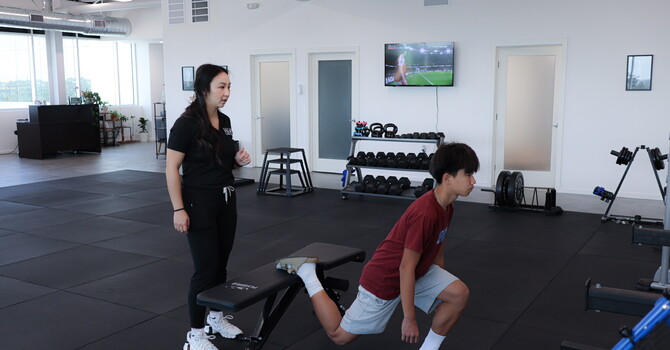
- Muscle activation: Bodyweight exercises performed lying on your back or side, which build awareness and control with minimal load.
- Upright functional exercises: Movements like sit-to-stands and step-ups that carry over to everyday life.
- Pre-impact training: Low-level loading that prepares the body for higher forces.
- Impact training and maintenance: Bone-loading exercise that supports long-term skeletal health.
Across these stages, we move from lower-resistance to higher-resistance exercise in a scaled, deliberate, and safe way.
"Wait, didn't you say to avoid impact training?"
Good question! Yes I did but only initially, and it depends on the results of your DEXA scan.
The early stages of a progressive program are about building muscle mass in the structures around your joints and bones. This teaches your body to absorb impact with muscle, rather than letting most of the force travel through the joint or bone.
Once you can control impact with your muscles, impact training actually becomes extremely beneficial. Bone responds to stress and builds new bone where force is felt. Resistance training first helps stimulate that response and prepares your bones to adapt. Jumping straight into impact training on fragile bone, on the other hand, can do more harm than good.
Think of it like training for a marathon. You wouldn't sign up without first building strength and running tolerance. You'd start with a couple of miles and add a little each week, building on your gains as you go.
Why working with a knowledgeable provider matters
Managing osteoporosis isn't just about knowing the diagnosis. It's about knowing how to scale exercise safely so you can reach your goals and live an active life without fear. As PTs, we see many patients with injuries that occur while participating in a sport. However, some of those patients are also seeking ways to improve their bone density after an official osteoporosis/osteopenia diagnosis. Through carefully curated exercises, we can directly target areas related to a patient's injuries and at the same time, prescribe exercises that will also help with bone density.
For more on how we approach osteoporosis and osteopenia at Valor PT, see our dedicated osteoporosis physical therapy page.
If you're unsure where to start, reach out to your physical therapist here at Valor Physical therapy in Carlsbad, CA to schedule an evaluation. Together, you can address your concerns and get you back to the active lifestyle you love.
References
O'Bryan SJ, Giuliano C, Woessner MN, et al. Progressive Resistance Training for Concomitant Increases in Muscle Strength and Bone Mineral Density in Older Adults: A Systematic Review and Meta-Analysis. Sports Med. 2022;52(8):1939-1960. doi:10.1007/s40279-022-01675-2
Frequently Asked Questions
Is it safe to exercise with osteoporosis?
Yes, with appropriate scaling. The key is starting with lower-impact activities and progressing gradually based on your DEXA scan results and your physical therapist's assessment.
Can I run or jump if I have osteoporosis?
Not initially. High-impact activities should be introduced gradually after building a foundation of strength and muscle activation around the affected bones. Many patients do return to impact training over time.
What exercises should I avoid with osteoporosis?
Deep forward bending of the spine, extreme trunk rotation, and high-impact activities without proper progression are the main categories to avoid early on, particularly if the spine or hip are affected.
How long does it take to see improvement with exercise for osteoporosis?
Bone density changes slowly. Most research shows meaningful improvements with consistent progressive resistance training over six to twelve months, though strength and balance improvements happen much sooner.
Do I need a referral to see a physical therapist for osteoporosis in California?
No. California's Direct Access Laws allow you to book directly with a PT without a doctor's referral."