At our clinic, we see a lot of active adults and kids who have goals to return to their sport. One major aspect of that is clearing them for participation, which is why return to sport testing is part of our sports injury rehab. Each athlete is tested based on their specific injury, sport, and position, which is why the two tests below look so different.
It would be easier if every athlete could be cleared once they hit one number or result. However, there is no specific number or metric that makes us hold someone back every single time. We use VALD performance testing to objectively measure strength, power, stability, and more, and those results matter. The numbers are just one part of the equation, though, and analyzing and understanding them is what helps us decide the next steps of rehab.
What return to sport testing looks like at our clinic
We use two VALD tools. The DynaMo is a dynamometer, or a tool that can measure a joint’s range of motion or a muscle’s strength in one fixed position. The ForceDecks are force plates that help us detect many different metrics during dynamic movements (jumps, hops, landings) or static ones (like standing still on one leg). Both of these tools help us create a better, more accurate picture of how the athlete is progressing.
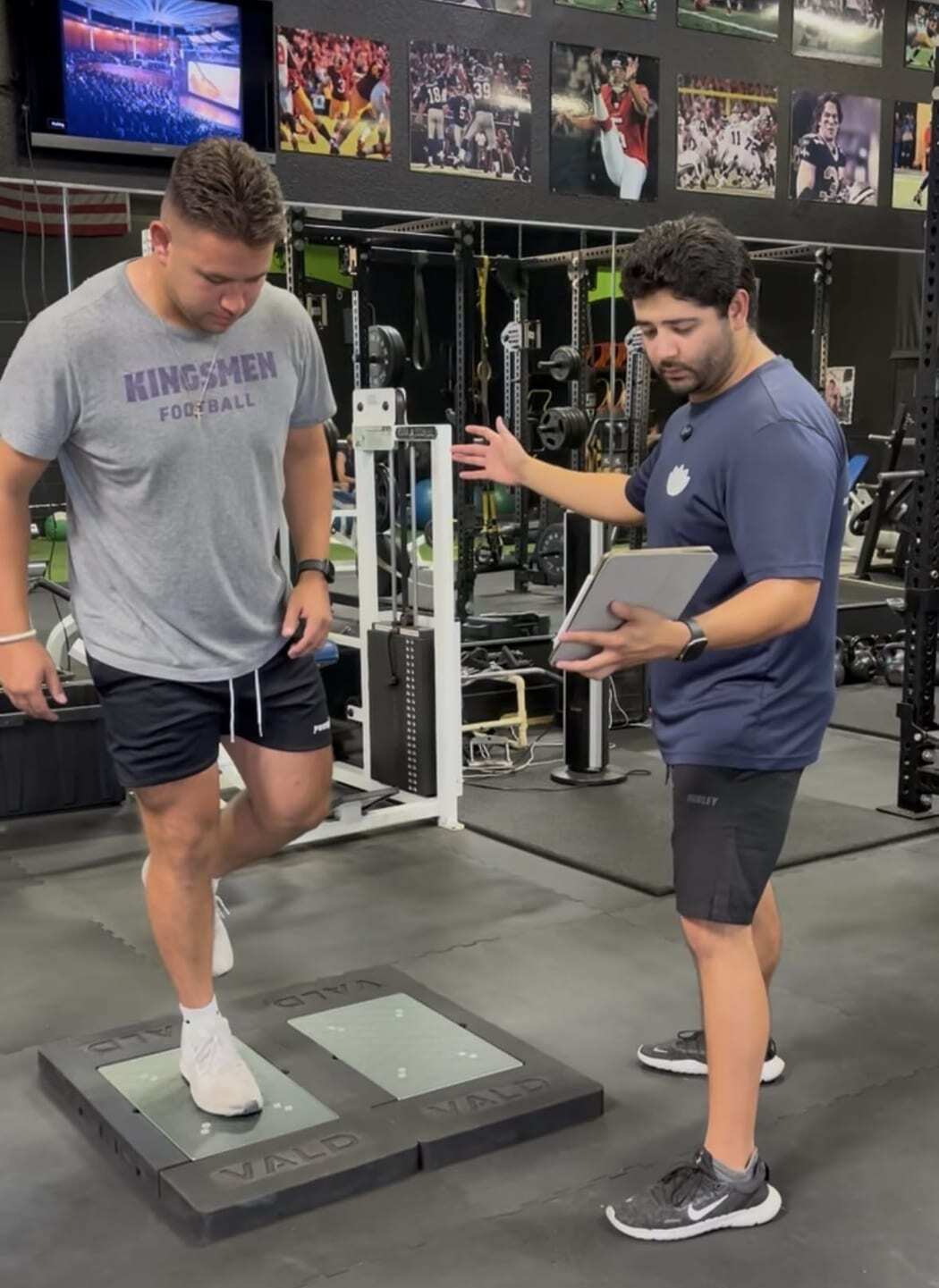
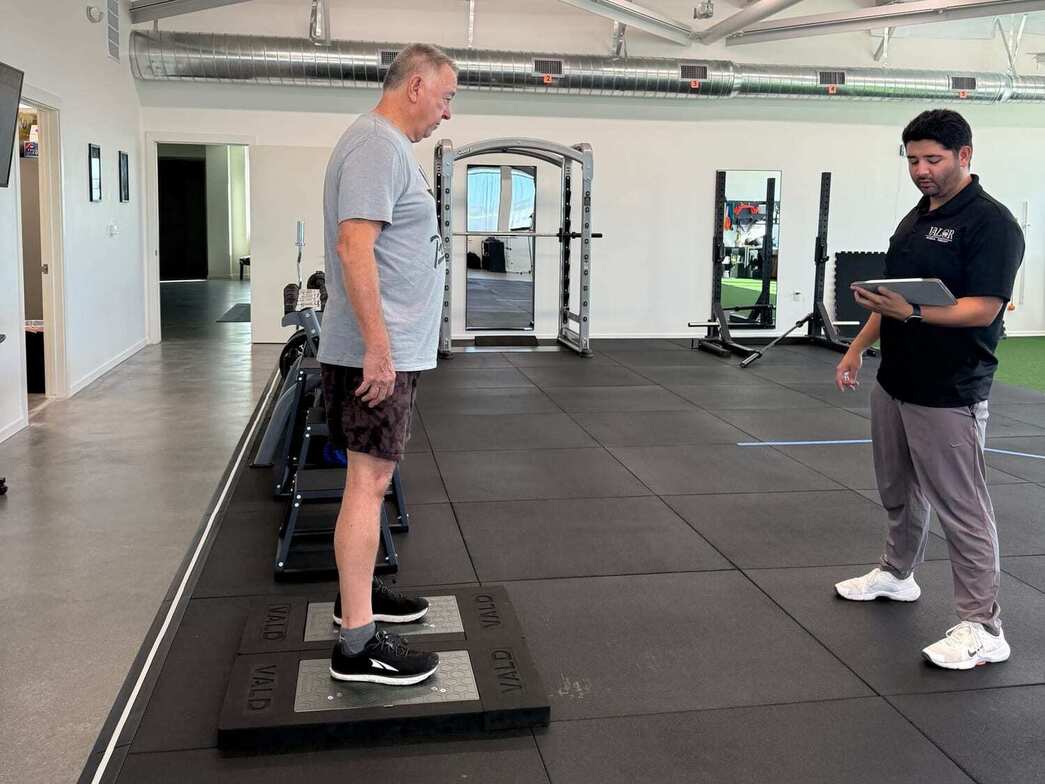
One of the athletes we’ve tested is a professional football kicker. In the photo above, he’s doing the “hop and return” test on the ForceDecks, where he hops on one foot over to the other plate and back to the starting plate. This test can help us determine his calf strength, ankle and foot stability, calf power and control, and how springy he can be in this lateral direction.
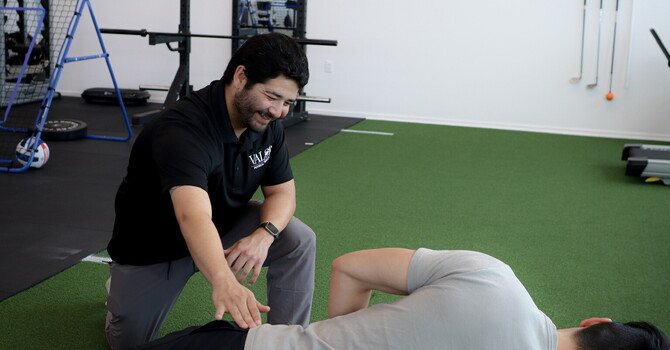
We’ve also tested a high-level Brazilian Jiu Jitsu athlete’s rotational strength with the DynaMo. With DynaMo strength testing, the athlete provides an isometric contraction (activating the muscle without moving the joint). She used a dowel to rotate into a handle attached to the device, and the force created through that tension told us her strength in that direction and how quickly she was able to produce it.
Using tension like this is also the approach researchers recommend for the DynaMo. In a 2025 reliability study of two VALD DynaMo models in 20 healthy adults, tests using tension were more reliable than tests where the tester holds the device against the limb. Most of those strength tests used the DynaMo Max, while our clinic has the DynaMo Plus, which the study tested for grip strength. Two of the authors have received research funding from VALD, and healthy adults aren’t injured athletes, so the study tells us the readings are repeatable, not how anyone will recover.
Is there a number that means an athlete is ready?
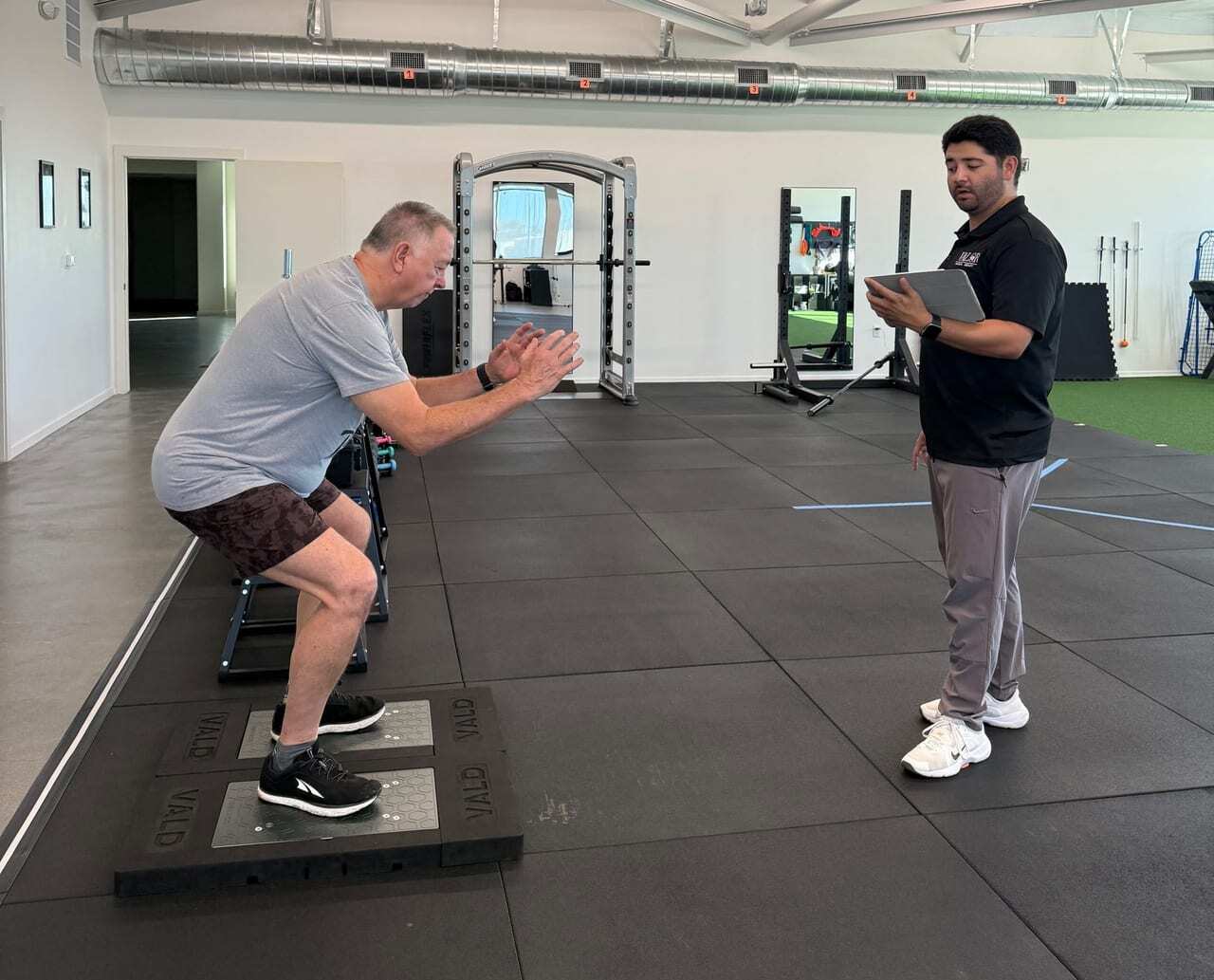
There isn’t one that applies to every athlete, but there is an order to what we look at. Typically, the first metric we pay attention to is strength, and asymmetry in strength when comparing the left and right side. Once the injured side is back above 90% of the other side’s strength, we can introduce more dynamic or plyometric movements (jumping, hopping, bounding). Using the ForceDecks can then help us measure and see what else we need to improve, whether that’s impact absorption, power asymmetries, how quickly they can move from one direction to the next, their stability when standing still, etc.
The same 90% mark shows up in research on athletes after ACL surgery. In the Delaware-Oslo ACL cohort, which followed 106 athletes in pivoting sports for two years after ACL reconstruction, passing the return to sport criteria meant scoring above 90 on every test, including quadriceps strength symmetry, hop test symmetry, and two self-reported knee function scores. More symmetrical quadriceps strength before going back was linked to a significantly lower reinjury rate.
Even so, passing a set of tests isn’t the whole decision. A 2016 consensus statement on return to sport, written by 17 expert clinicians after the First World Congress in Sports Physical Therapy in Bern, Switzerland, called the decision “complex and multifactorial.” The authors wrote that return to sport should be viewed as a continuum that runs alongside rehab, not a decision made in isolation at the end, and that it’s ideally made collaboratively by clinicians, athletes, and coaches. They also noted that research evidence to support these decisions was scarce.
That’s one reason we share results when it helps. With the athlete’s permission, we can send their VALD numbers to their coach, trainer, or strength and conditioning staff, so everyone is working from the same information. If I’ve already been communicating with an athlete’s surgeon, I make sure to give them updates throughout, too.
What a symmetry score can miss
While comparing the injured side with the other side is a useful starting point, it has a blind spot. If the uninjured leg also got weaker while the athlete was out, the injured leg can reach 90% of a weaker leg and look better on paper than it really is. In a study of 70 athletes after ACL reconstruction, 40 reached 90% symmetry on quadriceps strength and all four hop tests six months after surgery. When the researchers compared the injured leg with what the uninjured leg could do before surgery instead, 24 of those 40 athletes fell short of 90%.
This is one reason I like having numbers from before an injury. Athletes in our Athlete Advantage Program get VALD testing at their first assessment and at every quarterly assessment after that, so if they do get hurt, we already know what normal looks like for them. For everyone else, VALD compares results with data from other athletes of the same sport, age, and gender, which gives us another reference point besides the other leg.
How the numbers help with confidence
While achieving good numbers can help to progress the athlete, they can also affect an athlete’s confidence and trust in their injured limb. If someone is fearful of movement, these quantitative results can help improve their confidence or help narrow down our focus to specific factors during PT. That matters for getting back to sport, too. A systematic review of 11 studies and 983 injured athletes found that motivation, confidence, and low fear were associated with a greater likelihood of returning to their preinjury level of sport, and that fear was a prominent emotion at the time athletes went back. The authors described that evidence as preliminary.
I know some of that fear myself. When I started to get back on the mat after my own knee injury, I was scared. But I also knew that there were some things I could control. For an athlete coming back from an injury, objective numbers can be one of those things.
There are so many ways to use these tools, but choosing the tests, interpreting the numbers, and using them to dictate a treatment or training plan are how we help our athletes. If you’ve had an injury in the past or are curious about how to optimize your performance, you can book an evaluation with me or Dr. Brian Fonseca at our clinic in Carlsbad.
Come in and get tested!
References
- Collings TJ, Goodlich BI, Hams AH, Bourne MN. Reliability of VALD DynaMo dynamometer to assess upper and lower body isometric strength in healthy adults. Phys Ther Sport. 2025;75:135-143. https://doi.org/10.1016/j.ptsp.2025.08.005
- Grindem H, Snyder-Mackler L, Moksnes H, Engebretsen L, Risberg MA. Simple decision rules can reduce reinjury risk by 84% after ACL reconstruction: the Delaware-Oslo ACL cohort study. Br J Sports Med. 2016;50(13):804-8. https://doi.org/10.1136/bjsports-2016-096031
- Ardern CL, Glasgow P, Schneiders A, et al. 2016 Consensus statement on return to sport from the First World Congress in Sports Physical Therapy, Bern. Br J Sports Med. 2016;50(14):853-64. https://doi.org/10.1136/bjsports-2016-096278
- Wellsandt E, Failla MJ, Snyder-Mackler L. Limb Symmetry Indexes Can Overestimate Knee Function After Anterior Cruciate Ligament Injury. J Orthop Sports Phys Ther. 2017;47(5):334-338. https://doi.org/10.2519/jospt.2017.7285
- Ardern CL, Taylor NF, Feller JA, Webster KE. A systematic review of the psychological factors associated with returning to sport following injury. Br J Sports Med. 2013;47(17):1120-6. https://doi.org/10.1136/bjsports-2012-091203

Valentine Ngo
Contact Me