Can AI or ChatGPT Replace Physical Therapy?
More people than ever are turning to AI tools like ChatGPT for advice on pain, injuries, and training. It makes sense. AI is fast, free, and available at midnight when your knee is bothering you and you don't want to wait for an appointment. But there's an important question hiding behind that convenience: can AI actually replace physical therapy, or is it solving a different problem entirely?
The honest answer is that AI can be a genuinely useful starting point for general information, but it cannot replace the hands-on assessment, individualized diagnosis, and adaptive treatment plan that a licensed physical therapist provides. Here's what that actually means in practice.
What AI Can Help You With
AI tools are good at synthesizing general information quickly. If you're trying to understand a condition, learn common terminology, or get a rough sense of what might be going on, AI can be a reasonable first stop.
Some things AI genuinely does well:
- General education. Explaining what a rotator cuff is, what "tendinopathy" means, or how a typical ACL recovery timeline is usually structured.
- Basic exercise ideas. Suggesting generic stretches or strengthening exercises commonly associated with a specific complaint, like hip mobility drills for runners.
- Organizing information. Helping you track symptoms, prepare questions for an appointment, or summarize research you don't have time to read in full.
- Motivation and reminders. Some people use AI as a low-stakes accountability tool for home exercise programs they've already been given by a provider.
Used this way, AI functions similarly to a health article or a well-organized search result. It gives you information. It does not give you a diagnosis, and it cannot examine you.
Where AI Falls Short
This is the part that matters most, and it's where the difference between AI and physical therapy becomes clear.
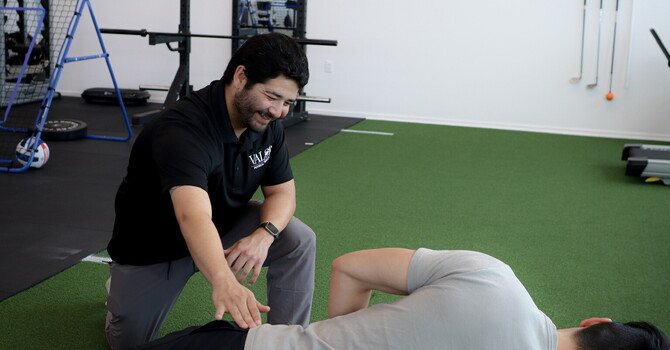
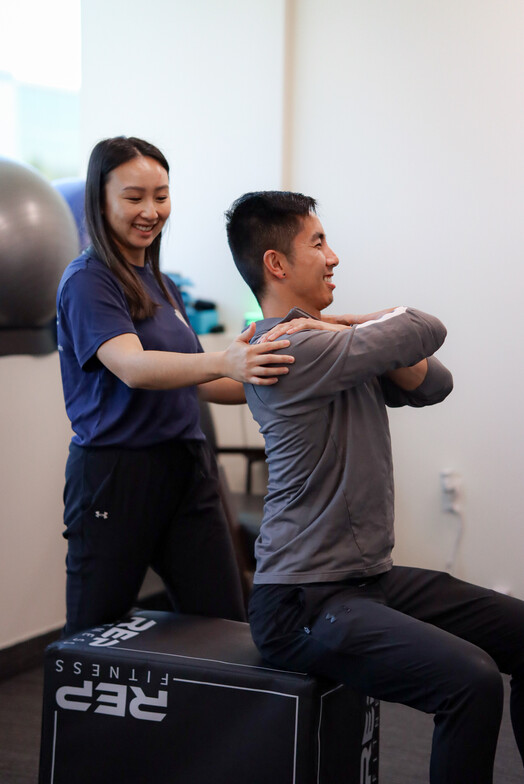
AI cannot physically assess you. A physical therapist evaluation includes hands-on testing: checking joint range of motion, assessing strength through manual resistance, watching how you move, and identifying compensations you may not even be aware of. AI has none of this information. It only has what you type into a chat box, which is often an incomplete or inaccurate picture of what's actually happening in your body.
AI gives generalized answers, not individualized ones. Two people with "knee pain" can have completely different underlying causes: one might have weak hip stabilizers causing poor knee tracking, another might have a meniscus issue, another might have referred pain from the lower back. AI will typically respond to the words you use, not the actual mechanical cause, because it has no way to test for one.
AI cannot adapt treatment in real time. A good rehab plan changes based on how your body responds. A physical therapist adjusts your program week to week (sometimes session to session) based on your progress, pain response, and movement quality. AI cannot observe any of that.
AI cannot catch red flags. Certain symptoms (numbness, night pain, unexplained weight loss, symptoms that don't fit a typical mechanical pattern) can indicate something more serious than a musculoskeletal issue. Recognizing when pain is not "just" a muscle or joint problem is a core part of clinical training, and it's not something a generalized AI model is positioned to reliably screen for.
AI has no accountability or liability. If AI-generated advice makes your symptoms worse, there's no clinical oversight and no one tracking your outcome. A physical therapist is a licensed provider responsible for your care and your progress.
Why Individualized, Person-Centered Care Matters
Rehabilitation isn't just about matching a symptom to a generic exercise list. It's about understanding your specific movement patterns, your specific history, your specific goals, and building a plan that adapts as your body changes.
This is true whether you're recovering from surgery, managing a nagging injury, or training for a sport. The exercises that help one runner with knee pain might be the wrong choice for another runner with the exact same complaint, because the underlying cause is different. This is the piece that generalized information, no matter how well-written, cannot replicate.
It's also worth noting that pain itself is complex. It's influenced by tissue health, movement mechanics, past injury history, stress, sleep, and more. A skilled clinician is trained to weigh all of these factors together. AI, by contrast, is working from pattern-matching across text. It is a fundamentally different kind of tool, built for a different kind of problem.
When You Actually Need a Physical Therapist
There are clear signals that it's time to move past general information and get an in-person evaluation:
- Pain that has lasted more than a couple of weeks without improvement
- Pain that limits your ability to work, train, or do daily activities
- An injury that happened suddenly, especially with swelling, instability, or loss of range of motion
- Numbness, tingling, or weakness
- Pain that keeps returning even after rest or generic stretching
- You're recovering from surgery
- You want a specific, progressive plan to return to a sport or activity, not just generic tips
- You've tried AI-suggested exercises and symptoms haven't improved, or have gotten worse
If any of these apply, that's the point where individualized clinical assessment becomes essential, not optional.
The Bottom Line
AI is a useful tool for general education, and there's nothing wrong with using it to learn more or prepare for an appointment. But it is not a substitute for a physical therapist, because it cannot examine your body, identify the actual cause of your pain, or adjust your plan as you progress. The best rehabilitation has always been, and continues to be, person-centered: built around your specific movement, your specific history, and real-time feedback from a trained clinician.
Think of AI as a helpful starting point for information. Think of physical therapy as the place where that information becomes an actual plan.
Curious what's actually causing your pain? Schedule a 1-on-1 evaluation with our team for a hands-on assessment and a plan built specifically around your body and your goals.
Frequently Asked Questions
Can ChatGPT diagnose an injury?
No. ChatGPT and similar AI tools can provide general information based on the symptoms you describe, but they cannot physically examine you, test your range of motion or strength, or rule out other causes of pain. A diagnosis requires a hands-on clinical evaluation.
Is it safe to use AI-suggested exercises for pain?
General, low-risk mobility or stretching suggestions are usually low stakes for mild, short-term discomfort. However, AI cannot account for your specific injury, movement compensations, or underlying cause, so exercises that seem reasonable in general could be the wrong choice for your specific situation, or could worsen certain injuries.
What can AI actually help with in physical therapy?
AI is useful for general education, organizing symptoms before an appointment, understanding medical terminology, and reinforcing a home exercise program that a physical therapist has already prescribed.
When should I stop relying on AI and see a physical therapist?
If pain persists beyond a couple of weeks, limits daily activity, involves numbness or weakness, followed a sudden injury, or hasn't improved with generic exercises, it's time for an in-person evaluation.
Will AI replace physical therapists in the future?
AI may become a more integrated tool for education, tracking, and communication within physical therapy, but the core of rehabilitation, hands-on assessment, individualized diagnosis, and adaptive treatment, requires human clinical judgment that current AI tools are not equipped to provide.