Physical Therapist vs. Chiropractor: Which Do You Need?
If you're dealing with back pain, joint discomfort, or an injury that won't quite resolve, you've probably wondered whether to see a physical therapist or a chiropractor. Both professions treat musculoskeletal issues, both can help you feel better, and both show up in the same search results when people are trying to figure out where to start. But they are not interchangeable, and understanding the difference can help you choose the right provider the first time instead of bouncing between offices.
If you're searching for answers in Carlsbad, you have no shortage of options for either. This guide breaks down what each profession actually does, where their approaches overlap, and where they diverge, so you can make an informed decision based on your specific situation.
The Short Answer
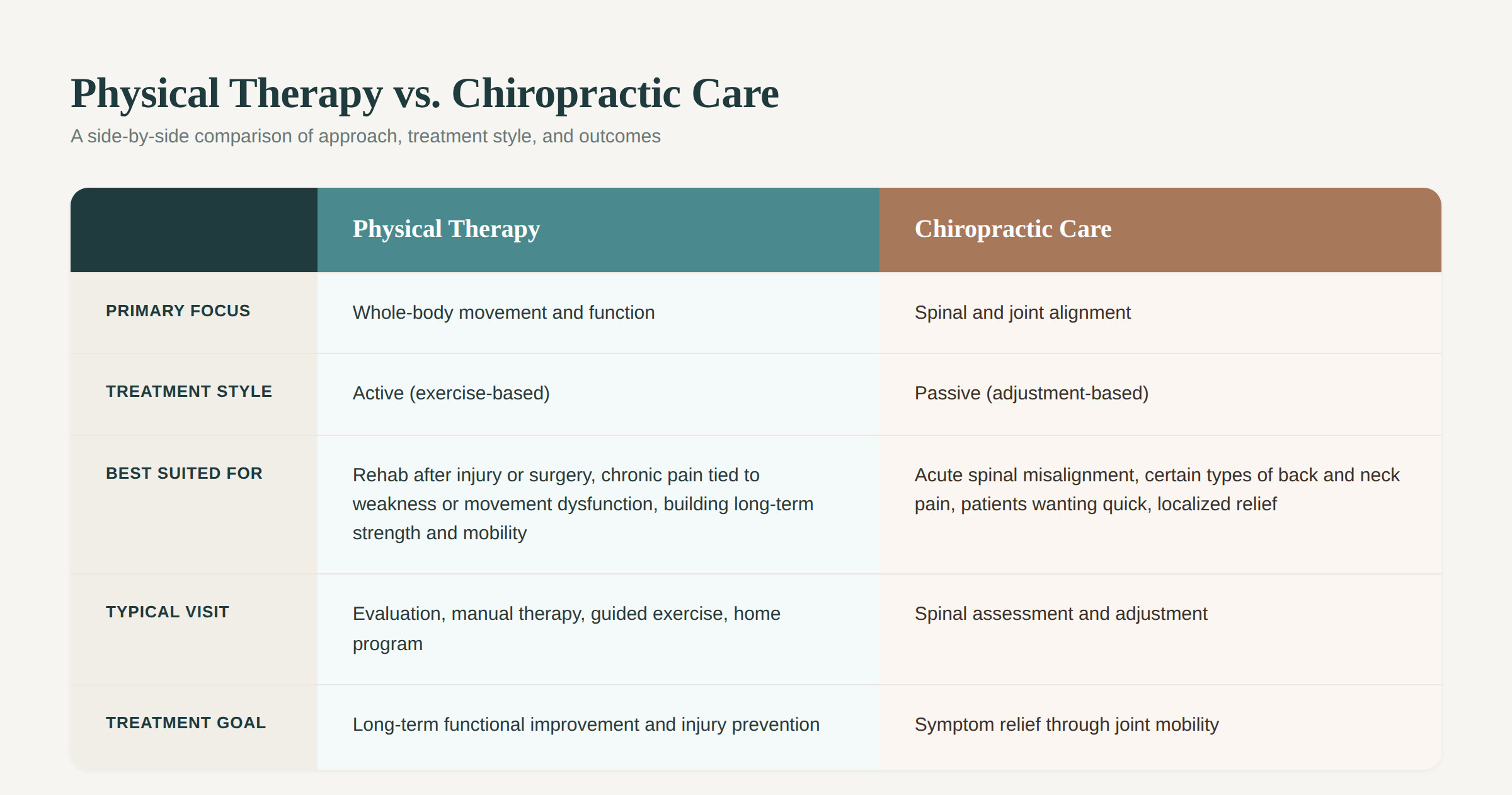
Physical therapists focus on restoring movement, strength, and function through active rehabilitation, education, and hands-on treatment. Chiropractors focus primarily on spinal alignment and joint manipulation to relieve pain and improve mobility.
Neither approach is universally "better." The right choice depends on what's causing your symptoms, what kind of long-term outcome you're looking for, and whether you need a treatment plan that builds strength and function over time versus more immediate, localized relief.
What a Physical Therapist Does
Physical therapists (PTs) are licensed healthcare providers who complete a Doctor of Physical Therapy (DPT) degree and pass a national licensing exam. Their training covers the entire musculoskeletal and neuromuscular system, not just the spine.
A typical PT evaluation includes:
- A movement and functional assessment (how you walk, squat, reach, or perform daily activities)
- Strength, mobility, and balance testing
- Identifying the root cause of pain, not just the location of it
- A personalized treatment plan that usually combines manual therapy, targeted exercise, and education
PT treatment tends to be active. You're not just receiving treatment, you're participating in it. Sessions often include therapeutic exercise, manual therapy techniques, and take-home programs designed to build strength and correct movement patterns that may be contributing to pain or injury.
Because PTs are trained to look at the entire kinetic chain, they're often the right choice when pain in one area is actually being caused by weakness or dysfunction somewhere else, such as knee pain caused by hip weakness, or shoulder pain caused by poor scapular mechanics.
What a Chiropractor Does
Chiropractors complete a Doctor of Chiropractic (DC) degree, with training centered on the spine, nervous system, and joint manipulation. The core chiropractic technique is spinal adjustment, sometimes called manipulation, which involves applying controlled force to a joint to improve alignment and range of motion.
A typical chiropractic visit includes:
- A spinal and postural assessment
- Manual adjustments to the spine or other joints
- Sometimes supplementary tools like electrical stimulation, ultrasound, or soft tissue work
- Ongoing visits, which for some patients become a regular maintenance routine
Chiropractic care tends to be more passive from the patient's side. You lie down, the adjustment is performed, and relief (when it happens) is often felt quickly. This can make chiropractic appealing for people looking for fast, localized symptom relief, particularly for certain types of back and neck pain.
Where the Two Approaches Overlap
Both professions:
- Treat musculoskeletal pain, including back, neck, and joint issues
- Aim to improve mobility and reduce pain without surgery or medication
- Use hands-on techniques as part of treatment
- Can be a reasonable first stop for new or nonspecific pain
For some conditions, patients see both providers, either at the same time or sequentially, and many PTs and chiropractors coordinate care when it benefits the patient.
Where They Differ
When Physical Therapy Is Specifically the Right Choice
There are situations where physical therapy is the more appropriate path, particularly when the goal is long-term recovery rather than short-term relief:
You're recovering from surgery. Post-surgical rehab requires a structured, progressive plan to safely rebuild strength and range of motion. This falls squarely within PT training and scope of practice.
Your pain is tied to weakness, poor movement patterns, or muscle imbalance. If the underlying cause of your pain is functional (a weak core contributing to back pain, poor hip stability contributing to knee pain), an adjustment may offer temporary relief, but it won't correct the pattern causing the problem. PT is built to identify and address that root cause.
You have a sports injury and want to return to activity safely. PTs design sport-specific rehab programs that rebuild strength, restore mobility, and reduce the risk of re-injury, with a clear plan to progress you back to full activity.
You want to build strength and prevent the issue from coming back. Because PT emphasizes active rehabilitation and home exercise programs, it's generally better suited for patients whose goal is long-term resilience rather than a single point of relief.
You're dealing with balance, coordination, or neurological issues. PTs are trained to treat conditions involving the nervous system's role in movement, which falls outside chiropractic scope.
You've tried chiropractic care and the relief isn't lasting. If adjustments provide short-term relief but symptoms keep returning, it's often a sign that an underlying strength or movement issue hasn't been addressed. This is a common reason patients transition to PT.
When Chiropractic Care May Be a Good Fit
Chiropractic care can be a reasonable choice for patients experiencing acute back or neck pain who are looking for fast, hands-on relief, particularly when the issue appears to be joint-related rather than tied to underlying weakness or movement dysfunction. Some patients also prefer the more passive nature of chiropractic treatment or use it as part of an ongoing maintenance routine.
How to Decide
A few questions can help point you in the right direction:
- Are you recovering from an injury or surgery, or trying to return to a sport or activity? Start with physical therapy.
- Do you want a treatment plan you actively participate in, with exercises you can do outside of appointments? Physical therapy.
- Is your main goal quick, localized relief from spinal or joint discomfort? Chiropractic care may help.
- Have you already tried adjustments without lasting results? Physical therapy is worth considering, since it targets the underlying cause rather than the symptom.
- Are you unsure what's causing your pain? A physical therapy evaluation is a good starting point, since PTs are trained to assess the full picture, not just the spine, and can refer you elsewhere if needed.
The Bottom Line
Chiropractic care and physical therapy aren't competing treatments so much as different tools for different jobs. Chiropractic care is often effective for acute, joint-related discomfort and quick relief. Physical therapy is built for rehabilitation, long-term strength, and addressing the root cause of pain, especially when surgery, injury, sport performance, or recurring symptoms are involved.
If you're not sure which path fits your situation, a physical therapy evaluation is a low-risk way to get a clear, professional assessment of what's actually going on and what your options are.
Have questions about whether physical therapy is right for you? Schedule a 1-on-1 evaluation with our team to get a clear picture of what's causing your pain and a plan to address it.
Frequently Asked Questions
Is a physical therapist or chiropractor better for lower back pain?
It depends on the cause. If the pain is linked to muscle weakness, poor posture, or movement dysfunction, physical therapy is generally more effective long-term because it addresses the underlying issue. If the pain is acute and joint-related, chiropractic adjustments may offer faster short-term relief.
Can I see both a physical therapist and a chiropractor?
Yes. Many patients use both, either together or at different stages of recovery, and providers often coordinate care when appropriate.
Do I need a doctor's referral to see a physical therapist?
In most states, including California, patients can see a physical therapist directly without a physician referral under direct access laws, though insurance coverage may vary.
Which is better for a sports injury?
Physical therapy is typically the better fit for sports injuries, since treatment focuses on restoring strength, mobility, and movement patterns needed to safely return to activity.
Why does chiropractic relief sometimes not last?
If an adjustment doesn't address the underlying strength or movement issue causing joint misalignment, symptoms can return. This is one of the most common reasons patients transition from chiropractic care to physical therapy for longer-lasting results.